Transforming Inks to Solid-State Coolers: High-Performance Silver Selenide and the Future of Thermoelectric Cooling
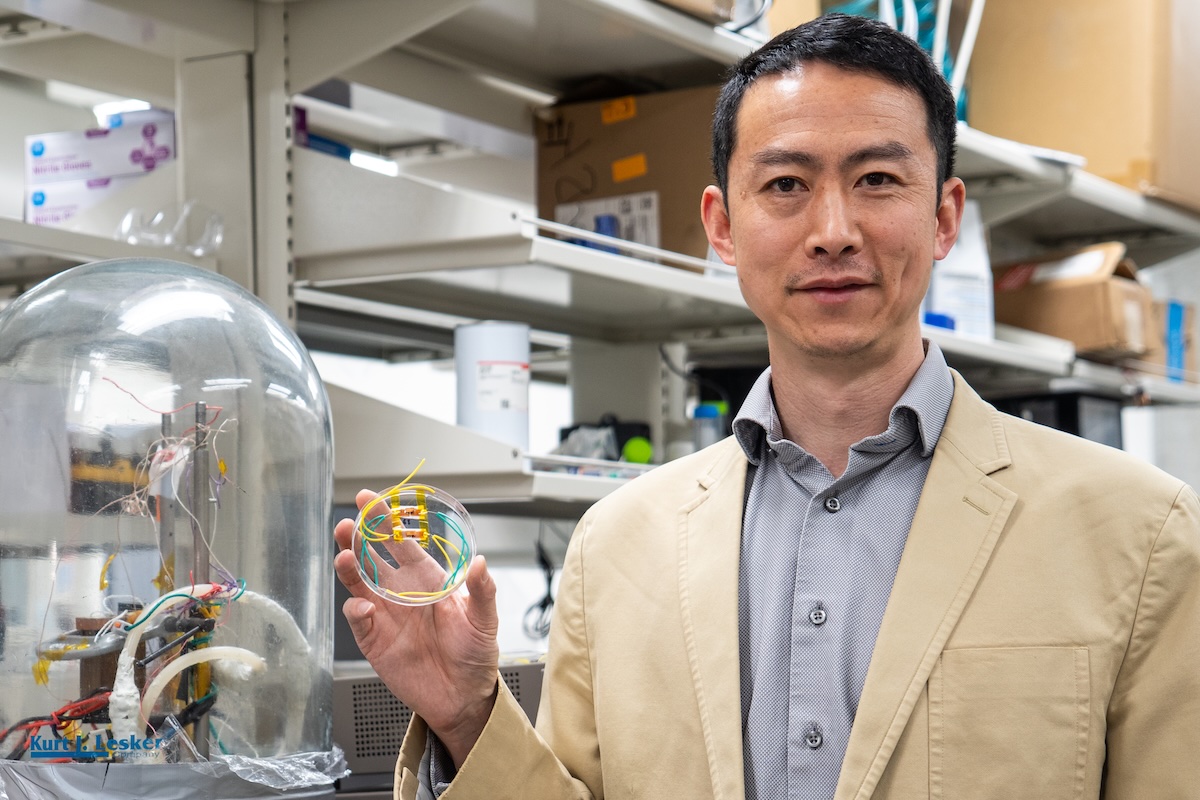
Today’s refrigerants come with a host of issues including leakage, emissions concerns, flammability, limited reclamation of used refrigerants, and many more challenges. However, a recent study published in Materials Horizons found promising options for next-generation cooling using thermoelectric technology, which has no moving parts, no gaseous refrigerants, and thus zero leaks.
Led by Yanliang Zhang, Advanced Materials and Manufacturing Collegiate professor of aerospace and mechanical engineering at the University of Notre Dame, the study showed that when combining ink-based processing of high-performance silver selenide and a high-throughput blade coating strategy, the result is solid-state thermoelectric coolers. This research was supported by the U.S. National Science Foundation (NSF) Environmentally Applied Refrigerant Technology Hub (EARTH) Engineering Research Center, the U.S. Department of Energy, and another NSF program.

“It's highly effective in cooling and very conducive to large-scale industry manufacturing,” Zhang said. “We can make the devices faster and with less cost. I think the biggest advantage of our process is its simplicity.”
He continued, “We use blade coating or screen printing to directly convert the initial inks into the final device pattern, the same process as screen printers use for artwork on t-shirts. But our ink contains silver and selenium elemental powders, which become the thermoelectric material after printing and post-print processing. We invented an ink that is highly compatible with the printing process, which allows for easy scalability.”
During the development process and when the research team initially combined the elemental silver and selenium powders to make the ink, they discovered that the silver and selenium reacted very quickly to form the silver selenide alloy. Zhang said, “This fast chemical reaction speeds the manufacturing process, which can be more cost-effective.” The alloy ink composition was then further optimized between the two elements to achieve the maximum thermoelectric performances.

Upon testing and comparing with current state-of-the-art bulk materials available today, the optimized printed materials achieved competitive room-temperature performances for both P-type and N-type components. The team’s earlier research focused on the printed P-type thermoelectric alloy, whereas the newer silver-selenium alloy material is for N-type thermoelectric materials. Both P-type and N-type components are needed to make a thermoelectric cooling device.
In the past, widespread adoption of thermoelectrics has been challenging due to the high costs associated with traditional manufacturing processes. However, this innovative ink-based printing strategy enables low-cost and high-performance thermoelectric materials and devices, which, according to the new study, “are very advantageous in energy-efficient and localized cooling of electronics, medical devices, automobiles, data centers, and buildings.”
“By making this thermoelectric device a competitive and commercially-viable technology, it can transform the way we cool things,” Zhang said. “We can make the cooling process become very environmentally friendly.”
This research aims to help establish a scalable, cost-effective manufacturing framework for next-generation thermoelectric cooling systems. As part of NSF EARTH’s mission to create the first sustainable refrigerant lifecycle-engineered system, these advances pave the way for producing high-efficiency, compact, solid-state cooling systems.
“We are continuing to investigate how to transform high-performance material into high-performance devices. We want to discover how we can combine the P-type and N-type semiconductors, the metal electrodes, and then connect all the components into a final complete system,” Zhang said. “We want to improve the material to the point that the Heating, Ventilation, Air-Conditioning, and Refrigeration (HVACR) industry will feel very confident to adopt it. Our goal is to bring our technology to the market to benefit all of society.”
Md Omarsany Bappy, a recent Ph.D. graduate from Zhang’s lab and assistant professor at Bangladesh University of Engineering and Technology, served as the first author on the paper, with contributions from other Notre Dame graduate students and postdoctoral scholars who led the machine learning and characterization aspects of the study. Tengfei Luo, the Dorini Family Professor for Energy Studies in the Department of Aerospace and Mechanical Engineering at the University of Notre Dame; Mercouri Kanatzidis, professor of chemistry at Northwestern University; as well as Berardo Matalucci and Allen Gray at MIMiC Systems also contributed to this research.
To learn more about NSF EARTH, please visit https://erc-earth.ku.edu
Please direct queries regarding this study to Prof. Yanliang Zhang, yzhang45@nd.edu.
EARTH Engineering Research Center
The Environmentally Applied Refrigerant Technology Hub (EARTH) is an NSF- and corporate-funded Engineering Research Center (ERC). EARTH is dedicated to revolutionizing how refrigerants are formulated, manufactured, applied, monitored, and recycled to dramatically reduce the environmental footprint of the global cooling sector. Led by the University of Kansas, this consortium of partner research universities includes the University of Notre Dame, University of Maryland, Lehigh University, University of South Dakota, and the University of Hawai′i.
Tue, 05/26/2026
author
Media Contacts

Environmentally Applied Refrigerant Technology Hub (EARTH)