EARTH: A New Way to View the Blue Sky
Academics and HVACR professionals say innovation is
equal parts imagination and science
When Irish physicist John Tyndall was conducting research on why the sky is blue, he explored the notion with awe, for the pure sake of the idea. As he performed his experiments at The Royal Institution in London, in 1869, he likely did not foresee that his work would inspire generations of scientists and entrepreneurs who would adopt the term “blue sky” to explain the tenets of basic research.
Tyndall certainly did not consider his discovery in the context of modern air conditioning, which would not be invented until 1902.
Nevertheless, his way of thinking is still powering the ubiquitous technology we use today.
“Blue sky research is unconstrained scientific exploration, the what if, the telescope of what might be possible,” said Tony von Sadovszky, the Innovation Officer at EARTH, an engineering research center funded by the National Science Foundation and U.S. corporate support. “These ideas are early stage, unbounded invention without guardrails, telling us where the science is leading, serving as the groundwork for later commercial opportunities.”
Von Sadovszky was sharing his views at a recent industry forum hosted by EARTH – the Environmentally Applied Refrigerant Technology Hub.

The forum gathered more than 130 people, including faculty and students from six universities, community college professors, and professionals from numerous companies working in the heating, ventilation, air conditioning and refrigeration (HVACR) sector. From numerous perspectives came a unified mission: to conduct cutting-edge research that helps industry to innovate, leading to new products and services and meaningful careers.
During a fireside chat with EARTH Industry Liaison Officer Casey Williams, von Sadovszky formed a bridge between the complex academic research underway and business concepts such as blue sky technologies, blue ocean strategies and deep tech. Both are based at the University of Kansas, EARTH’s lead university and forum host.
“Blue Ocean is about markets; capturing the value in blue sky technologies to create new uncontested market spaces, versus a red ocean with blood in the water from folks squeaking out three percent market share,” said von Sadovszky, echoing the book Blue Ocean Strategy by Chan Kim and Renée Mauborgne.
For example, the current refrigerant market could be seen as a red ocean. But finding ways to recycle used refrigerant – the kind one would find in a dusty AC window unit – could lead to new sources of chemical compounds that companies can use to manufacture new solar panels and electric car batteries: blue ocean.
“Engineering the practical; translating the science into defensible, scalable innovations would be described as deep tech, which is the core NSF ERC vision,” von Sadovszky said.
Ed Maginn, Keough-Hesburgh Professor of Engineering and Associate Vice President for Research at the University of Notre Dame, likened the use of known molecules to a red ocean in his presentation at the forum.
“In the known chemical space…there are millions of molecules,” Maginn said. “Still, none of them are new; someone has figured them out.”
Video: Notre Dame's Ed Maginn speaks at the industry forum
Researchers today are beginning to search outside the boundaries of contested space, akin to swimming in a pink ocean, Maginn said. “I’d say this is where cutting-edge technology in our industry is. How we make advances is slow and it’s expensive and it takes a lot of time. It requires a lot of people.”
Enter machine learning and AI.
It’s the only way to accelerate research, to find the new molecules that can lead to advanced materials that the HVACR sector needs to innovate, said Maginn, co-author of a peer-reviewed article on the use of machine learning in molecular discovery.
Still, artificial intelligence is a function of human intelligence.
“Graduate students come in ready to absorb knowledge…but it takes time for them to learn these new tools; it’s not something you can do in a week,” Maginn said. “That’s part of the timescales mismatch between academia and industry.”
Maginn told the industry forum crowd that he had worked in industry before graduate school.
“I remember thinking there are three timescales in industry: over coffee, over lunch and over night.”
The private sector’s need for speed actually reinforces EARTH’s value, he said.
“This consortium can help blend in different technologies at different stages of the development cycle. Industry can build on academic research at various stages” and get to market faster, he said.
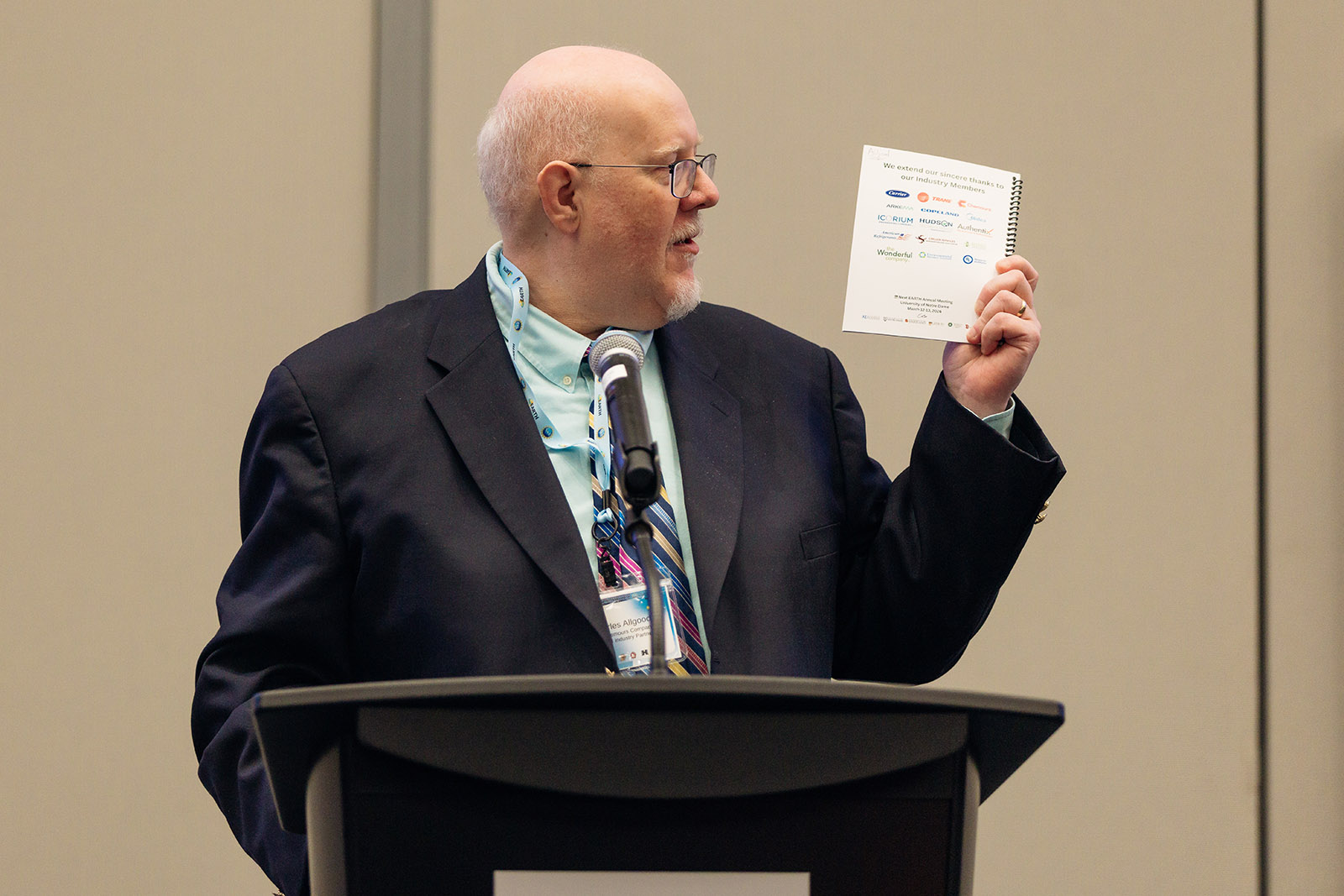
Chuck Allgood, technology fellow at Chemours and chair of EARTH’s Industrial Advisory Board, also believes that government, academia and business should partner to solve complex problems.
As he held up the forum brochure, he pointed to the companies supporting EARTH: “You can see the logos of the companies there, really leaders in the global HVACR industry for years. [Even if] you’re a chemical refrigerant manufacturer like my company, a refrigerant on its own isn’t going to do anything for anybody. It needs to go into a system, and those systems are represented by the companies here.”
His remarks provided context for the blue sky conversations that would take place later in the day.
“If we look at the long acronym, NSF ERC EARTH, the basis is science,” Allgood said. “Accurate data, reliable data, reproducible, peer-reviewed research is really the foundation on how we built this whole industry.”
Public policies come and go, from energy efficiency standards to trade policy, he said. Amidst those changes, “We want sound, science-based, data-driven decisions for all that.”
He urged professionals from non-member companies to join EARTH, advising they would find a lot of common ground.
“These companies aren’t charities,” he said. “We’re a publicly traded company. Our shareholders have invested in us and we need to be good stewards of that investment. The fact that we have companies investing in EARTH speaks to all the aspects of EARTH, the future, and all the benefits we see.”
Click here to view the photo gallery from the EARTH Industry Forum.